There exist any number of conspiracy theories regarding the distribution of Covid-19. The most popular ones are that Bill Gates or 5G towers somehow released the virus, and the most plausible ones are that the virus either escaped or was purposely released from a Chinese biolab. The theory which I personally find the most intriguing, though, is that Covid-19 was released by some world government for environmental and social reasons - or, in other words, for the benefit of its population.
Of course, this theory is completely baseless (not to mention completely insane). Biological warfare is probably not the conclusion most world leaders would jump to when hoping to garner patriotism, and most don't value patriotism particularly strongly anyway. The theory stems not from any critical thought on the cause of the virus but instead from observing its effects, and indeed, it is all but undeniable that the effects of Covid-19 have been at least partially beneficial. Maybe not concretely so, but on a more abstract level, we see that Covid-19 has fostered a stronger sense of community, with the distribution of signs asking everyone to "hang in there," or some other similar platitude. Not all businesses can close, but the ones that do offer respite, and the ones that don't experience financial success that boosts the earnings of workers. As much as people complain about lockdown and social distancing, it is perfectly arguable that Covid-19 has done more good than bad.
In my last post, I discussed the fact that the images used in media during the Covid crisis have primarily been images of hope and enduring rationality rather than images of fear and suffering, and I argued that this may partially be the result of an effort to distract from the nonexistence of such suffering by manipulating positive emotions. Unfortunately, I did not take as nuanced a position on this issue as I would have liked. There are a few factors I didn't consider which I would like to reintroduce here.
That the media focuses on positive images is not unprecedented, and in fact may be the standard, though I personally have not lived through enough crises to say. I mentioned 9/11 in my last post but neglected the fact that there were just as many hopeful and assertive images as there were photos of death and destruction. Harriman and Lucaites address this when they discuss patriotism in the wake of 9/11, saying "the many thousands of flag images... included many striking images of patriotism and resolve" (Harriman and Lucaites 129) and addressing specifically a picture of firemen raising a flag which went on to feature more prominently than any of the thousands of other pictures taken at Ground Zero that day. Positivity is something to which people naturally attach themselves, and it offers some sense of power to see the firemen raising an American flag in spite of the ruin America had just suffered.
However, blind positivity doesn't quite lubricate the American mind as these observations would suggest. Returning to Harriman and Lucaites, they contrast the extremely famous photo of soldiers raising a flag on Iwo Jima with the practically unknown photo of the immediate aftermath. The "follow-up photograph, according to the common sense of snapshot photography, should be the preferred picture" (Harriman and Lucaites 97), they say, but it obviously is not. The first photo always looks to me like raising the flag is a great struggle, perhaps even a last stand after a bloody battle (fitting for Iwo Jima.) The second could be any photo of any soldiers with no particular context. There's a reason there are no news stories about the economy running like a well-oiled machine or improved quality of life. Positivity doesn't breed in positive environments. Positivity breeds in periods of struggle, when it is absolutely necessary. It is much more impressive to be positive in the wake of death and destruction, and just as this is the impact of the Iwo Jima photo, so too is it the impact of the Covid-19 images.
This is the last post this blog is likely to ever receive, and frankly, it seems like the best possible note to end on. I don't mean that this is the best written the post could be; I'm not that arrogant. I mean that this is the best narrative that could end the prevailing arc of Performative Pandemic Politics. Of course, though we write our posts as commentary on narratives, it is inescapable that they should be narratives as well. The narrative thus far has been that the state and the media are using Covid-19 for personal benefit. I believe this is true. I also believe that, as cynically as we've treated the handling of the crisis, there are certainly some good things to say. Covid-19 gave rise to a world with less bickering and more cooperation. Perhaps that's the narrative that future history classes will accept.
Goodnight, and goodbye.
Friday, May 15, 2020

Sunday, May 10, 2020
Will an Iconic Image Arise from the Coronavirus Crisis?
 |
| "Accidental Napalm" |
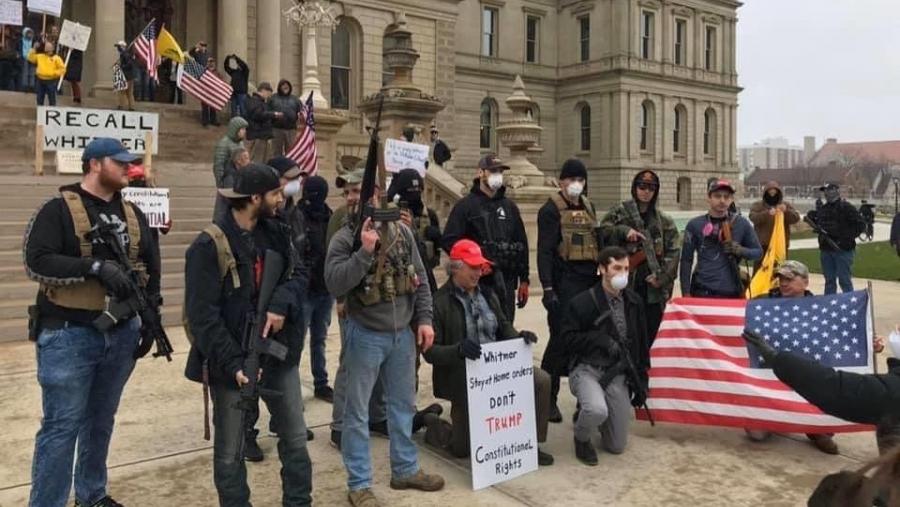 |
| Protesters at the Michigan capital |
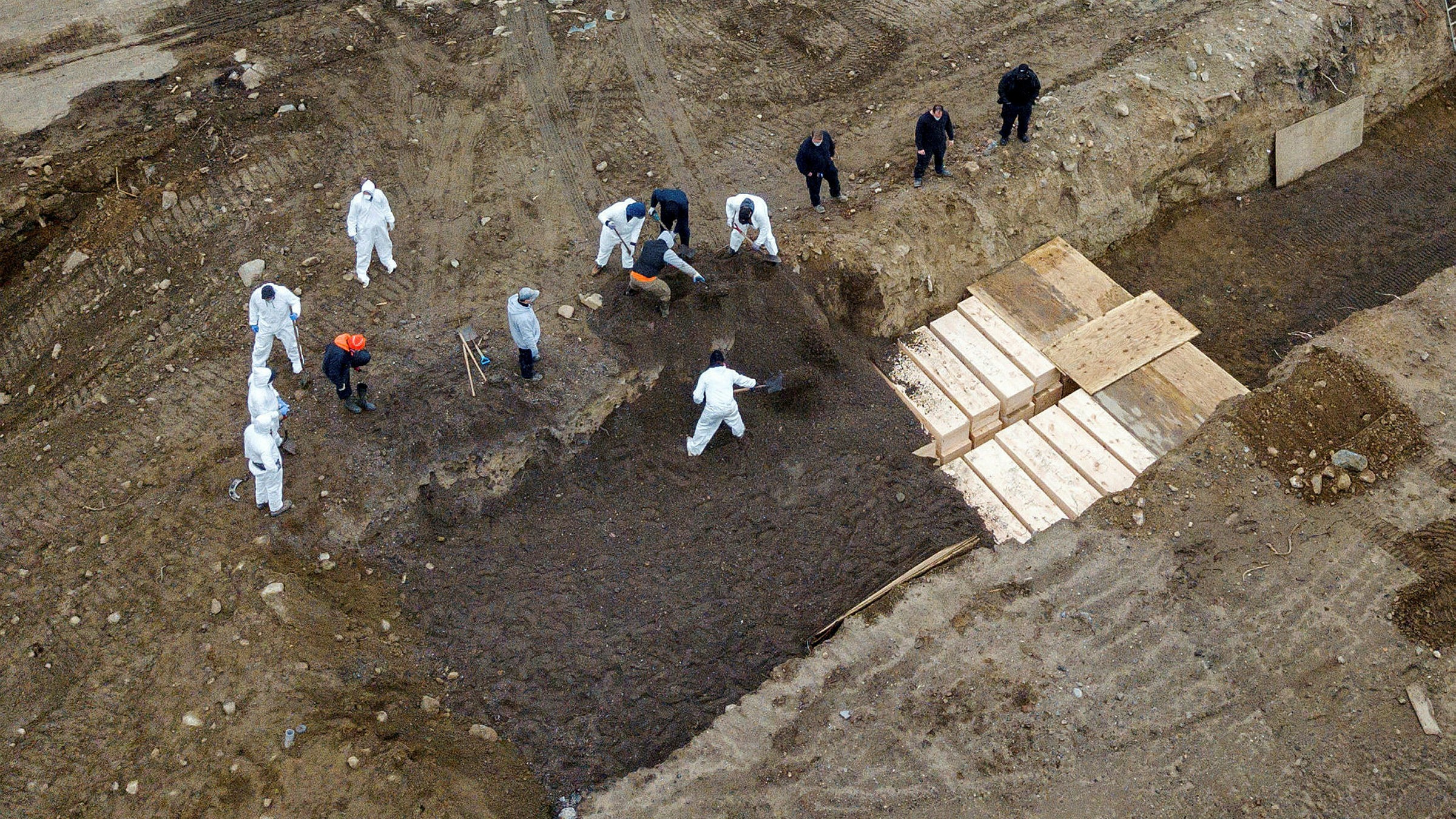 |
| Mass graves in New York |
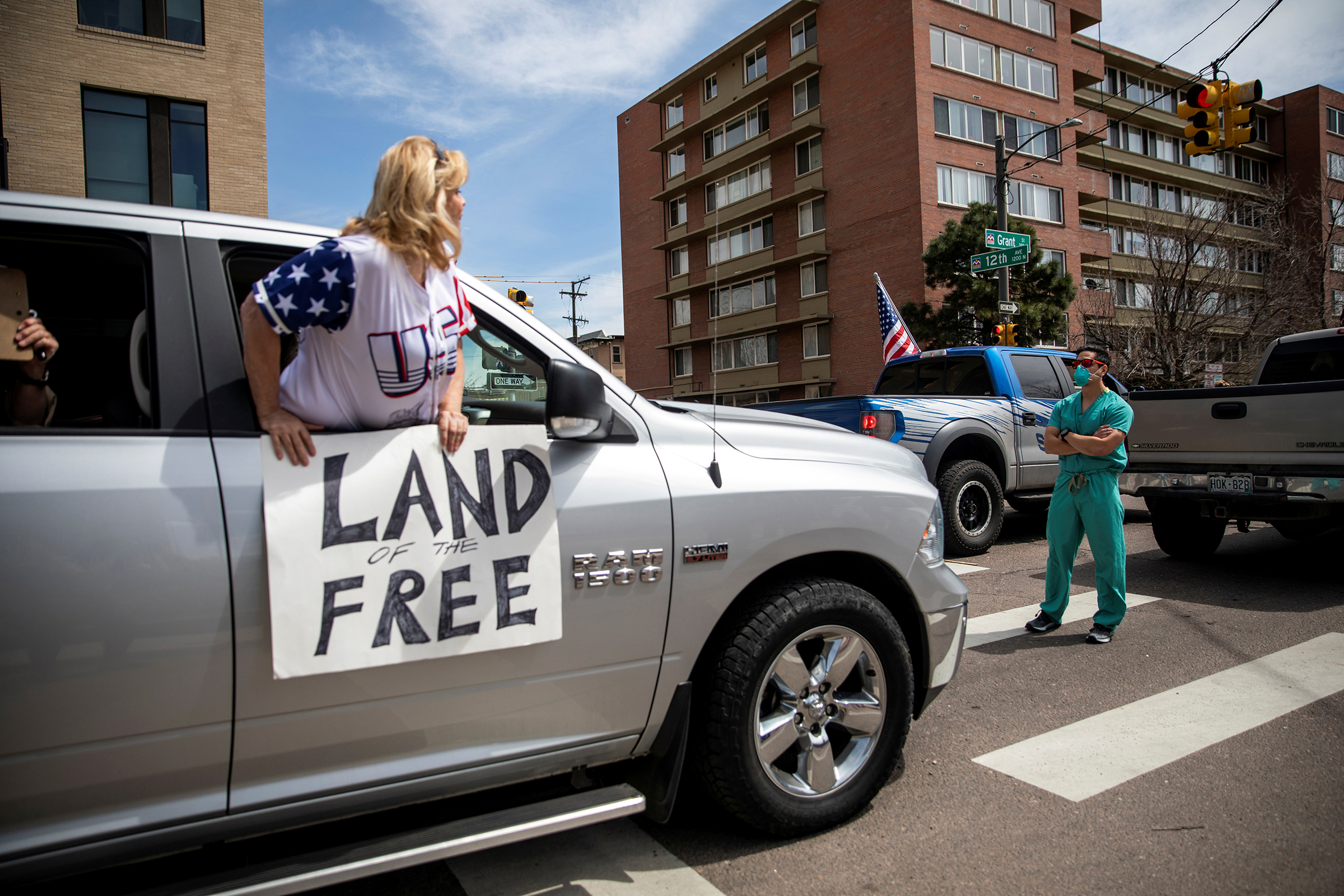 |
| A protester and counter-protester in Denver |
We will have to wait and see if one photograph becomes the iconic image of the COVID crisis. We don’t know what it will be, it probably has not been taken yet. But using the images above, we gain some insight into what themes it might show.
The Power of Homelessness as an Icon in San Francisco

Tents are pitched on Fifth Street down the block from the largest homeless shelter in San Francisco, Calif.,
Saturday, March 21, 2020. (Karl Mondon/Bay Area News Group)
San Francisco has long held a reputation for being rife with homelessness. The ever-growing visibility of the problem has turned the images of homeless encampments that litter the sidewalks into iconic images of not just the city but of the apparent failure of liberal democracy. As “the principle of equality is necessary for both legitimacy and social cohesion in a democratic society” (Hariman & Lucaites, p.43), we see the lack of equality in these images as representative of a greater breakdown of social order.
These issues are more evident than ever as the global COVID-19 pandemic has sent the nation into lockdown, leaving those without a home exposed to the deadly virus, while the rest of society is afforded relative safety as they isolate. Recent images of the ballooning homeless population in San Francisco show rows and rows of tents along sidewalks as the homeless try in vain to shelter against the invisible virus. The images of homelessness in San Francisco have been effective in the past in promoting change through their emotional currency. In the last 15 years, San Francisco has housed over 27,000 homeless people, and doubled their budget to target the issue, increasing annual expenditures to over $300 million. (Fagan, 2019) In spite of these efforts, however, the homelessness issue persists and the city's ritualized culture of “being charitable with the homeless” (Matier, 2020) has made the city a congregation point for homeless individuals from across the state seeking assistance during the pandemic.
Images of these congregating individuals have an iconic quality such that “they are believed to provide definitive representation of political crises and motivate public action on behalf of democratic values.” (Hariman & Lucaites, p.45) And there is already evidence of their success: residents and business owners sued the city in an effort to force the city to address the dangers posed by a lack of social distancing among the homeless, and a lack of adequate access to sanitation in the wake of many closures of homeless-aid programs to protect employees from exposure. (Fagan, 2020) The focus of all liberal-democratic movements is to challenge and expand “conceptions of citizenship, social justice, and political community.” (Hariman & Lucaites, p.45) The effect of these images on public culture and feelings of collective obligation can be seen in the sudden funding for the almost 1,000 tents that have been handed out by homeless advocates since the crisis began. (Fagan, 2020)
Iconic images are important in their emotional appeal, which is established through their origin in times of conflict or confusion. (Hariman & Lucaites, p.36) The emotions held within the photographs serve to generate “the fusing of public and private sensibilities, the heightening of intensity, [and] feelings of solidarity and empathy.” (Hariman & Lucaites, p.37) As a result these emotions become political in nature and directly lead to the enactment of political change. Currently the outcry of public opinion has meant that there is increased pressure on Mayor London Breed to provide emergency housing and to get people into their own rooms regardless of their infection status. (Matier, 2020) Hopefully these images will serve to further galvanize the public into addressing the homeless population of San Francisco even as the crisis abates in the future.
Absence of Evidence and Evidence of Absence
Images might be the most effectively persuasive tool that narratives have. Anyone can say that napalming Vietnam is bad, but to see a little girl running naked through the streets because all of her clothes caught on fire is a much more emotional experience. It's hard to imagine a narrative that was not strengthened by the use of images, except for one: the 2020 Covid pandemic.
Crises make for good opportunities for political action; it seems unlikely that the US would ever go to war with Iraq if not for September 11th. Harriman and Lucaites argue that images of crises, like the Vietnam war, provide backing for political goals when they say "commentary on the Web repeatedly turned to the images from [the Vietnam War] in order to comprehend the new photos of Americans [in Iraq]." (Harriman and Lucaites 173) The existence of this blog proves that Covid, while perhaps less dramatic, is being used similarly, as players like Trump, Sanders, and Biden have all used Covid as a piece of a greater argument. However, part of what makes crises so useful is their emotional connection. As stated above, images generally cause greater emotional reactions than verbal arguments. Why, then, have none of these players used images in their arguments?
That's a bit hyperbolic. Images are seen with some regularity in discussions of Covid-19. The problem is that they're not the images anyone would reasonably expect. In times of crisis, the argument is usually that the world is in such unrest that it needs a great leader - the one supported by the narrative - to swoop in and save everyone. I once again direct your attention to September 11th, used in just such a way to justify the actions of Dick Cheney. Famous images from 9/11 include smoking skyscrapers, crying firefighters in mountains of rubble, bodies falling from incredible heights towards death. Bush's approval ratings immediately after skyrocketed, and the correlation is easy to explain. By emphasizing pain and suffering, Bush's camp accomplished two goals: first, it exaggerated the necessity of retaliation, and second, it clouded judgment with feelings. Together, this made the choice to invade Iraq seem more reasonable that it actually was. Thus, one would expect images of Covid-19 to be much more dire, perhaps showing bodies piling in the streets or grandmothers choking on their own mucus. Instead, narratives seem to take the Jonathan Shay approach, using images of trauma "to construct a narrative of one's life that can contextualize the traumatic moment." (Harriman and Lucaites 183) The most popular Covid-19 images have been quite hopeful, showing nurses triumphantly opposing forces of evil and joyfully combating danger. The fact that Covid-19 is an illness shouldn't make a difference, either. The more dramatic images were popular during crises like swine flu and ebola; even as far back as the Spanish Flu did we see pictures of deaths upon deaths. The question then becomes why Covid-19 doesn't use these images, and how that benefits players.
The brief answer is that the images don't exist. Deaths from Covid-19 are more manageable than those of earlier diseases. Ebola took place in western Africa, a region without the infrastructure necessary to take care of an epidemic or the piles of bodies that the epidemic created, and Spanish Flu was much more contagious and deadlier, so it makes sense that as more people died it would become to difficult to contain and necessitate throwing out cadavers. Covid-19 has none of these qualities, and Wuhan, the one place suspected to actually have piles of bodies, won't provide images to use. Covid does not kill enough to support call-for-action narratives. In this way, ignoring the crisis visually is in fact the best way to write the narrative. There is, of course, the fear of the unknown. Because so many people misunderstand Covid-19, they come to wild conclusions that it is much deadlier and scarier than it truly is. More importantly, though, is that writers of narratives can play on the public's ignorance. When audiences don't know whether bodies are piling in the streets are not, and they are willing to accept whatever they are told, it is enough to simply say that bodies are piling in the streets. Repeat this constantly from every media source, and suddenly it becomes an obvious and inalienable truth, perpetuated not just by the media but by consumers of the media, until resistance is unthinkable. This strategy is fantastic, as it creates not just followers but followers who actively discourage breaking from the general consensus. Unfortunately, it is also reliant on a lack of images. If images are used, then the audience comes to understand that they've been fed exaggerated information. As opposed to other crises, which inundate people with so much information that they become emotionally attached to the state of affairs, Covid-19 withholds information so that people are emotionally attached to the emotions they are told to feel.
Covid-19 makes for an excellent narrative not in spite of the fact that it's unverifiable but because of it. People felt the ramifications of 9/11 in their daily lives, but they experience Covid-19 through a computer screen. This might seem to weaken the impact, and perhaps it does, but the advantages of this setup are undeniable. When none of your information comes from personal experience, all of your information is what you are told to believe.
Crises make for good opportunities for political action; it seems unlikely that the US would ever go to war with Iraq if not for September 11th. Harriman and Lucaites argue that images of crises, like the Vietnam war, provide backing for political goals when they say "commentary on the Web repeatedly turned to the images from [the Vietnam War] in order to comprehend the new photos of Americans [in Iraq]." (Harriman and Lucaites 173) The existence of this blog proves that Covid, while perhaps less dramatic, is being used similarly, as players like Trump, Sanders, and Biden have all used Covid as a piece of a greater argument. However, part of what makes crises so useful is their emotional connection. As stated above, images generally cause greater emotional reactions than verbal arguments. Why, then, have none of these players used images in their arguments?
That's a bit hyperbolic. Images are seen with some regularity in discussions of Covid-19. The problem is that they're not the images anyone would reasonably expect. In times of crisis, the argument is usually that the world is in such unrest that it needs a great leader - the one supported by the narrative - to swoop in and save everyone. I once again direct your attention to September 11th, used in just such a way to justify the actions of Dick Cheney. Famous images from 9/11 include smoking skyscrapers, crying firefighters in mountains of rubble, bodies falling from incredible heights towards death. Bush's approval ratings immediately after skyrocketed, and the correlation is easy to explain. By emphasizing pain and suffering, Bush's camp accomplished two goals: first, it exaggerated the necessity of retaliation, and second, it clouded judgment with feelings. Together, this made the choice to invade Iraq seem more reasonable that it actually was. Thus, one would expect images of Covid-19 to be much more dire, perhaps showing bodies piling in the streets or grandmothers choking on their own mucus. Instead, narratives seem to take the Jonathan Shay approach, using images of trauma "to construct a narrative of one's life that can contextualize the traumatic moment." (Harriman and Lucaites 183) The most popular Covid-19 images have been quite hopeful, showing nurses triumphantly opposing forces of evil and joyfully combating danger. The fact that Covid-19 is an illness shouldn't make a difference, either. The more dramatic images were popular during crises like swine flu and ebola; even as far back as the Spanish Flu did we see pictures of deaths upon deaths. The question then becomes why Covid-19 doesn't use these images, and how that benefits players.
The brief answer is that the images don't exist. Deaths from Covid-19 are more manageable than those of earlier diseases. Ebola took place in western Africa, a region without the infrastructure necessary to take care of an epidemic or the piles of bodies that the epidemic created, and Spanish Flu was much more contagious and deadlier, so it makes sense that as more people died it would become to difficult to contain and necessitate throwing out cadavers. Covid-19 has none of these qualities, and Wuhan, the one place suspected to actually have piles of bodies, won't provide images to use. Covid does not kill enough to support call-for-action narratives. In this way, ignoring the crisis visually is in fact the best way to write the narrative. There is, of course, the fear of the unknown. Because so many people misunderstand Covid-19, they come to wild conclusions that it is much deadlier and scarier than it truly is. More importantly, though, is that writers of narratives can play on the public's ignorance. When audiences don't know whether bodies are piling in the streets are not, and they are willing to accept whatever they are told, it is enough to simply say that bodies are piling in the streets. Repeat this constantly from every media source, and suddenly it becomes an obvious and inalienable truth, perpetuated not just by the media but by consumers of the media, until resistance is unthinkable. This strategy is fantastic, as it creates not just followers but followers who actively discourage breaking from the general consensus. Unfortunately, it is also reliant on a lack of images. If images are used, then the audience comes to understand that they've been fed exaggerated information. As opposed to other crises, which inundate people with so much information that they become emotionally attached to the state of affairs, Covid-19 withholds information so that people are emotionally attached to the emotions they are told to feel.
Covid-19 makes for an excellent narrative not in spite of the fact that it's unverifiable but because of it. People felt the ramifications of 9/11 in their daily lives, but they experience Covid-19 through a computer screen. This might seem to weaken the impact, and perhaps it does, but the advantages of this setup are undeniable. When none of your information comes from personal experience, all of your information is what you are told to believe.
Reframing the Virus Icon
 When going for a walk around my neighborhood, I noticed a sign leaned up against the playground gate. The imagery printed on the sign struck me as both familiar and out of place. A glaring, overblown image of the virus occupied the majority of available space on the sign, and seemed to be its intended focus. The information printed below this blown-up virus image read: “Public Facility Closed”. The odd choice of layout of the sign, paired with its playground context was jarring. It felt like I had walked up to a mugshot posted up for neighborhood watch, not a public health notice cautioning safety.
My instinct in identify the sign as having a mugshot-like quality brings up an interesting point. The abnormality of this global crisis is that the coronavirus pandemic does not and cannot wear a human face. It is faceless by nature. Nonetheless, in encountering imagery of the virus, I was tempted to ascribe to it a human quality. It is this specific image, the same one replicated on the sign, that has become iconicized by the media, specifically because it lends itself so easily to this subconscious act of humanization. After all, successful icons "...recreate recognizable moments of social performance" (Hariman and Lucaites 32).

The iconic image is made up of one singular viral shape, which acts almost as a headshot, that is then juxtaposed with a dark background, which draws attention to the formal qualities of the viral body itself, such as its red spikes and circular form. It is important to remember that these formal qualities are simply computer-renedered interpretations of the real virus, and its true form is unrecognizable to the human eye. The computer-rendered nature of the virus icon, as well as our inability to see it in its natural form, reflects the importance of science and technology during this pandemic and their influence in constructing the pandemic narrative. The simplistic and accessible nature of this virus image has allowed it to become humanized by the public, and its multiplicity and reproduction in the media have contributed to it iconicization. This anthropomorphized image of the virus has become an icon of the pandemic.
It can be argued that by giving the pandemic this face, we have chosen to iconicize imagery that is unfamiliar and in every way removed from humanness, valuing it over images of humanity and hope. "The image activates available structures of feeling within the audience" (Hariman and Lucaites 35), and this specific choice of icon reflects public feeling of the pandemic as an isolating and dehumanizing event.
Although some aspects of this argument are true, I believe that our collective choice of non-human icon for this moment does not reflect a removal of humanity, but rather exposes a shortcoming in our ability to interpret the actors in the mis-en-scene of this crisis. We have never before been faced with a non-human actor in a tragic play of this magnitude. The choice of iconicizing the viral image over a human one does not represent a defeat of humanity but rather an adaptation. In taking action to create an iconic "face" for the virus, we are able to ground it as an actor in the pandemic, making it accountable and creating a sense of certainty in a time that severely lacks it. By framing the icon of the virus on our own terms, we are able to reconcile its presence in our lives and, hopefully, recognize our ability to overcome it.
Saturday, May 9, 2020
One Letter: Images of Mo(u)rning in America
The Lincoln Project’s “Mourning in America” ad has gone viral, racking up over two million views as of the publication of this post and gaining attention from the president himself. It is one of few instances during the Trump presidency that an organization of Republican majority has put themselves not only in opposition to him but also critiqued his performance during this pandemic. The construction of this ad deserves recognition and analysis on its own, but it would be remiss not to recognize the juxtaposition with its clear source of inspiration, “Morning in America,” an ad for Reagan’s reelection campaign in 1984. The two ads are stark contrasts in their values and tones, and nowhere is this more evident than in its imaging.
Both are living records of the ways their creators view their respective eras. Reagan’s emphasis is on preserving paradise, an idyllic America which he helped to construct. The country, under his guidance, sees a bustling economy, families settled and satisfied with their lives, the prospects of vowed love in marriages and citizens raising and gazing up with admiration at the American flag. This footage becomes inextricably interwoven with Reagan’s America, and its sentiment of good prospects and hope is therefore politicized. The people in the camera’s frame are, as Hariman and Lucaites state, “put into a social relationship with the viewer” to encourage voters to again elect Reagan and again choose another 4 years of prosperous and hopeful days. These images see iconic reproduction in Lincoln Project’s much more salient advertisement -- the America shown in this advertisement’s footage is also rife with flags and people in day-to-day life. The most significant difference is the tear of this constructed “social relationship”: images connecting the American people and the flag are absent, as the virus began work on severing them and ineffective politicians like Trump are seen to have finished the job. The emotional scenario constructed in the Reagan ad -- existing already in a good place and striving even further for improvement -- is dashed in the current America.
The Lincoln Project’s position is communicated with unflinching clarity in this ad and the expectations placed by its predecessor and now subverted: the America which we inhabit now is being derailed by its current president rather than being elevated by it. It is a position viewers see not only in the scripted messages and contexts of these advertisements but also in the selected images between them. The emotional break in iconography signals one constant between the presidential elections in 1984 and this upcoming one in 2020: voting means shaping the direction of the country’s future, either in sustaining one ongoing positive presidency or in avoiding four more years of another that could further break down American life.
Thursday, April 30, 2020
Turning Tragedy into Agency
The COVID19 pandemic is truly a harrowing time for some. Around the world, families are losing their income, people are losing their home and loved ones, health insurance and financial security are being ripped away, and mental health is on a general decline from isolation. Back in the global Spanish Flu Pandemic of 1918, industrial production and consumption slowed dramatically,but it picked back up within a year to be higher and faster-paced than it ever had been before; “In 1918, influenza had a far greater effect on worldwide trends in industry, production and consumption than the first world war… Yet today when we look back at demographic and economic trends, that last great pandemic appears as a small blip with few long-term consequences” (Dorling, 2020). However, in the same Guardian article by Dorling, the current economy is described to be in a ‘slowdown’. The economy hasn’t been accelerating and growing, even prior to this pandemic. We just haven’t noticed because until now, it has been almost unnoticeable.
The news of the pandemic is full of images of healthcare workers with nearly bloody lines cut into their faces from wearing masks for hours on end. There are images of protesters, and protesters protesting the other protest. Images of truckers and grocery store workers sleeping in their cars or garages so as to not infect their families. Images of doctors crying outside of hospitals, and family waving through glass panes. Photographs of people who have lost their jobs, of farmers having to destroy their produce. Shelves empty, production assembly lines halted, city centers as ghost towns. It is these images that we will think of when we remember this pandemic. These images are haunting, they show people struggling, and they often evoke images we see from times of war or the great depression. In the book No Caption Needed, Robert Hairman and John Louis Lucaites, discuss the way tragic photographs make issues personal, “By activating this deep register of moral response, the photograph coun- teracts the conventional political realism that places war and international relations generally outside the moral circumference of domestic politics” (Hairman et al., 178). This is interesting, because it is important in how we move forward from the pandemic. If we focus our visual energy on the people the pandemic is harming, the people who have lost jobs and the tired faces of essential workers, we make the tragedy about the people still living. We cannot afford to focus on showing images of the virus or images of the people it has claimed. That wouldn’t allow us to work towards a healthier future. In this way, iconic photographs can be understood to be drivers of narrative, or catalysts. When done correctly, they push progress and care forward, and lessen the powerless feeling of a truly apocalyptic narrative where people choose to do nothing.
Moving forward, these images will be important to keep in mind, as it seems we have a slow path towards economic recovery and may not return to acceleration; “since the 1930s, technological change has slowed; the rate of economic growth has slowed every decade after the 1950s; population growth similarly has slowed since before the 1970s; and since at least the 1990s we have started to behave more like our parents again. By the 2010s we (at least in the rich world) were no longer seeing each generation better-off than the one before” (Dorling, 2020). This slowdown, and change is a good thing. The rate we were moving at, and we expected to continue moving at was not sustainable. Not sustainable for our planet, or for our country. To conclude, the pandemic and the chilling photographs of life at a standstill, may allow tragedy to be turned into optimism; “Everything was slowing down already, everything will still slow down when the current crisis ends. But the slamming on of the brakes on the train we were travelling on might, at the very least, wake us out of our stupor” (Dorling, 2020). The pause was necessary.
Monday, April 27, 2020
Pandemic Protest Motivators: Trump’s Charismatic Leadership
As the coronavirus pandemic
continues to sweep the nation, tensions are rising as new, tighter restrictions
continue to be imposed and enforced in order to lessen the consequences of the
deadly virus. Michigan in particular has been a hotbed of unrest, with Governor
Gretchen Whitmer facing backlash after the announcement of her latest
stay-at-home order. Michigan has been one of the hardest hit states in the
nation, with the third-highest number of confirmed coronavirus-related deaths, according to data collected by the Center
for Disease Control and Prevention. To reduce the rate of
infection within the state, Whitmer’s executive order on April 9th imposed some
of the country’s tightest restrictions. Even amidst tough restrictions,
Governor Whitmer has the support of the majority of the state. A poll released
on April 20th by the Detroit
Regional Chamber of Commerce found that 57 percent of Michigan residents approved of
Whitmer, compared to only 37 percent who disapproved of her approach to the
crisis. However, these new mandates were not received well by all Michigan
residents, with thousands of far-right conservatives flocking to the state
capital of Lansing to protest. Many of the protestors flew Trump 2020 flags and
sported MAGA gear as they demonstrated over concerns that the new stay-at-home
order is in violation of constitutional rights. Regardless of the favorable
opinion shown in the polls, and the support of the majority of Michigan voters,
the impact of the protest was still significant. Despite the protest being
ostensibly called to oppose the additional restrictions, it was also “the
clearest sign yet of a simmering ideological movement on the right resisting
government mandates over the virus” (Gabriel
and Marin, 2020).
The spotlight was initially shone on
Whitmer last month when President Trump cavalierly referred to her as “the
woman in Michigan.” (Zeleny,
2020) Whitmer has become a political target as she is widely considered to be a
potential contender to run alongside Joe Biden as vice president. Even if she
is not selected as the vice presidential nominee, her popularity may help the Democratic party
win Michigan in the presidential election. Trump has continued to make other condescending
comments about her, including referring to her as “Gretchen ‘Half’ Whitmer,” and
describing her as being “in over her head." (Mehta,
2020) Trump’s success as a charismatic leader against a rival depends on
his ability to creatively redefine legitimate leadership and cast his opponents
as “unworthy challengers.” (Joosse,
2018) Trump’s disregard for the norms that have traditionally governed
political behavior has made him extremely compelling to certain audiences. On the
other hand, his opponents, including Governor Whitmer, rarely stray from the traditional
norms of civility, making it challenging for them to respond to his often racist, sexist,
and xenophobic comments. Trump further established Whitmer as an “unworthy
challenger” by openly opposing her radical approach to the coronavirus crisis
as he discusses easing national guidelines for social distancing, and then
drawing upon the protests as evidence of Whitmer’s performative failure.
In a tweet posted on the Friday
following the demonstration, President Trump called upon his followers to
“Liberate Michigan” despite the clear reports of the protestors being in
violation of federal social distancing guidelines (Gabriel
and Marin, 2020). The blatant disregard of the safety of Michigan residents
indicates Trump’s intentions to use this crisis as a political platform for the
upcoming presidential election rather than to address the pandemic as the
catastrophic health crisis that it is. Trump’s charismatic leadership has
earned him an extensive group of “devoted followers.” According to Paul
Joosse’s theory of charismatic counter-roles, individuals are more likely
to participate in a cause if they expect a large number of other people to
participate as well. As a result, “leaders may be tempted to draw attention to
the performances of devoted followers as a means of setting up conditions that
are favorable for motivating others to join the movement.” (Joosse,
2018) In this particular case, Trump’s endorsement of protestors serves as
a way to gain more followers by demonstrating his legitimacy through the
performed devotion of the protestors.
Trump is continuing to establish his
charismatic authority through performative interactions with both his “devoted
followers” and “unworthy challengers”. Through these interactions, Trump
ensures that he “is cast as eminently competent while the conventional rivals
are rendered seemingly inexperienced, ill equipped, and outmoded.” (Joosse,
2018) These interactions also establish his social value as a result of
the “triangular relationship between the leader, enraptured followers, and
witnesses who are party to, and potentially inspired by, the devotional
performances of the followers.” (Joosse,
2018) Trump has used the pandemic crisis and his authority as charismatic
leader to further his own ends in pursuit of another presidential term by
utilizing charismatic counter-roles to provide authenticity to his
performance.
Sunday, April 26, 2020
Pandemic Protest Motivators: Karakaya's Spectacle Seekers
 |
| Protesters left their cars and formed an impromptu rally. (NPR) |

In “The Conquest of Hearts”, Karakaya defines three main groups of people that she sees interacting with President Recep Tayyip Erdoğan’s political rallies in Turkey. The group she calls “spectacle seekers”, enjoy Erdoğan’s rallies. They believe that the events do a good job conveying important emotions about their countries heritage and history of conquest, and the enthusiasm one should feel for their nation. Karakaya’s interviewees said the rallies “make me proud, really….I mean you just go back to the past when you watch this” and “these kinds of enthusiasms and exuberances infuse you with new excitement, which is necessary”. We can see this same view from rally-goers in the United States, and specifically at “Operation Gridlock”. First, the slogan “make America great again”, present at every a Trump rally and the protest in Michigan, is a call to remember and epitomize portions of the United States’ past, much like the rallies in Turkey do with their Ottoman history. Also, the ralliers in Michigan projected tones of conquest, chanting “lock her up”, similar to the way Erdoğan’s rallies hark back to the Ottoman’s conquest. Finally, the “spectacle seekers” Karakaya interviews expressed pride in their country through the events, and rally participants in on the 15th showed their pride as well, through American flags and Lee Greenwood’s “God bless the USA”.
A valid response to this analysis is to question whether we can truly characterize the sub-protest in Michigan as a political rally (I questioned myself as I wrote). But the definitive proof, I believe, comes in the form of a New York Times article. The journalists found that the protests across the country were nurtured by “an informal coalition of influential conservative leaders and groups, some with close connections to the White House”, who are attempting to turn unhappiness over stay-at-home orders into votes in November. When protests turn out to be gatherings to rustle-up votes, it seems to be fair to categorize them as political rallies. In these rallies, through the attitudes of the attendees, we can see “spectacle seekers” as a group prompting protest rallies during the pandemic.
At the Podium: Dissonance Between Press Briefings and Trump Rallies
The focal point amidst continuing turmoil caused by COVID-19 is the federal government. More succinctly, the White House’s James S. Brady Press Briefing Room and its recent, frequent visitors -- including President Trump, VP Pence and members of the White House Coronavirus Task Force -- have emerged as the focal point of pertinent information distribution. Today is the first time since Easter that the daily briefings have ceased, at the behest of Trump’s administration and even Trump himself. This is likely because the briefings themselves have transitioned into something completely outside their intended purposes. Some conjecture that the briefings have become more like rallies, the president’s primary expression of his opinions and way of connecting to his supporters. Because this is an election year, the president’s appearances in these briefings have seemed to shift the briefings’ subjects from guidance through the pandemic to rhetoric aligned with the president’s policy stances and partisan opinions. This shift, in turn, has forged a new parallel in iconicity.
In both settings, Trump operates in the charismatic authority style, one of three leadership styles posited by Max Weber. Though dabbling in qualities of traditional authority and steering from legal-rational authority, he relates most distinctly with generating charisma to invite his supporters further into his ideology. This is an observation made too by sociologist Paul Joose, who points out that “Weber places followers, not leaders, at the center of his etiological account of charismatic power” (“Countering Trump”). He and his followers are a package deal: the MAGA and KAG clothing apparel they don, alongside their uproarious support of his proclamations and booing of his opponents, are bombastic and unyielding. Both in large groups and individually, in appearance and in disposition, Trumpian supporters have become iconic. They evoke intense emotion because they themselves are firm in their intensity, standing behind Trump when he takes the stage or cheering from the unseen crowd. They are a show of support and unanimity, emblematic of his values. Without those supporters attending his rallies, it would be difficult for him to assert his influential position. This is the reality we have seen play out when putting that same figure into the coronavirus briefings.
In the White House briefing room, no one is manifesting any sonic or visual sign of support. The humanitarian and numeral depression this pandemic has taken, both on human lives and almost every corner of the economy, requires a shift in tone. Trump himself has not adapted to this loss in supportive iconography, and the consequences of that fact are playing out in real time. This is why Trump has faced so much pushback in the briefing setting: his assertions were made without the visual backing of his supporters. Behind him were officials from the federal government who were and remain serious in acting in public interest. In front of him was an audience of journalists pressing for clarification beyond his typical superlative-laced speech over the specifics behind his intentions and language. The absence of his iconic supporters has proven damaging to his authority as a charismatic leader, and so it’s no surprise that with his acceleration of reopening states, he has also made it a priority to reunite with that support as soon as possible.
Subscribe to:
Comments (Atom)